The translation we quote
Unless noted otherwise, every direct Edda excerpt on this site uses Henry Adams Bellows's translation of The Poetic Edda (1923), which is in the public domain in the United States. It is freely readable at Project Gutenberg and the Internet Sacred Text Archive. We quote it because we can do so cleanly and legally, and because its slightly archaic diction suits a devotional register.
Another public-domain translation
Olive Bray's The Elder or Poetic Edda (1908) is also public domain and useful for comparison. Early translations carry the assumptions of their era, so we treat them as source material to weigh against each other — not as final authority.
Modern translations — recommended, not reproduced
Modern translations are often clearer and better informed, but they are under copyright. We will happily recommend them for your own study and quote them only briefly and with attribution when needed. If you buy one book to go deeper, a modern translation is the one to buy.
Historical honesty
Modern Norse Paganism and Heathenry are living reconstructions, not an unbroken line from the Viking Age. The written sources we have — the Poetic Edda, the Prose Edda, sagas, law codes, archaeology — were mostly recorded after conversion to Christianity, by people with their own aims. We say "many modern practitioners," "one approach," "historically attested in part," "inspired by," or "a modern devotional adaptation," because those phrases are true. Certainty here is usually a sign someone is selling something.
Practice disclaimer
This site is a modern spiritual resource — not an academic authority, a religious governing body, a medical or legal service, or a substitute for local ecological rules. Any practice on public or shared land should be clean, legal, and respectful of the place, its wildlife, and the people who tend it.
Site artwork
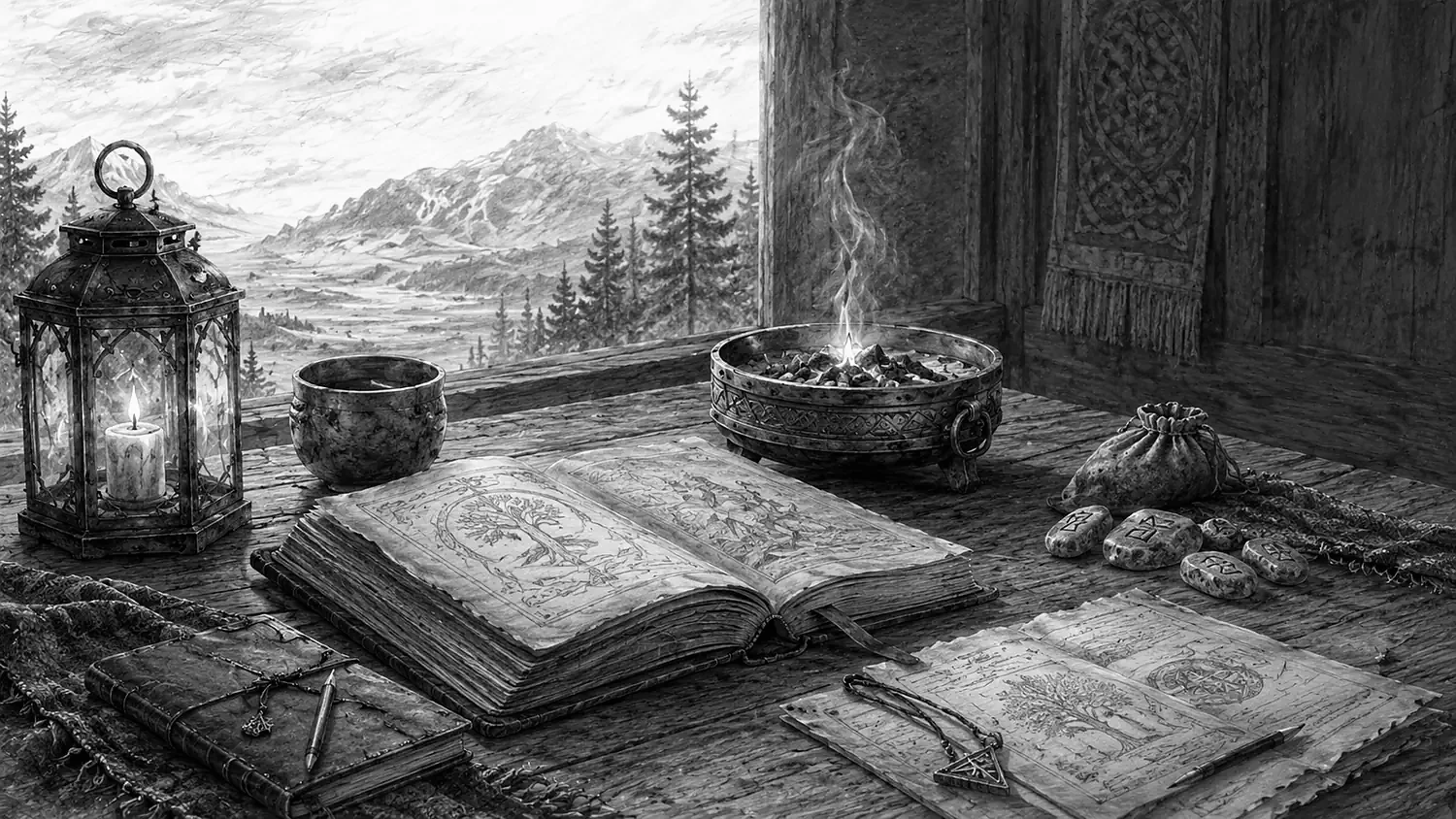
The grayscale illustrations on this site are original AI-assisted artwork created for The Portable Hearth. They are meant as atmospheric, devotional, and practical visual support — not historical reconstructions, archaeological evidence, or claims about exactly how ancient people or gods looked.
A starter bibliography
A place to begin, not a canon. Read widely, compare translations, and form your own judgment.
- Henry Adams Bellows, trans., The Poetic Edda (public domain).
- Olive Bray, trans., The Elder or Poetic Edda (public domain).
- Carolyne Larrington, trans., The Poetic Edda (modern, copyrighted).
- Jackson Crawford, trans., The Poetic Edda (modern, copyrighted).
- Rudolf Simek, Dictionary of Northern Mythology (reference).
A note on how to read this site
Take what is useful, test it against better sources, and leave the rest. Disagreement is part of a healthy practice. The poems have survived a thousand years of readers arguing with them; they can survive you too.