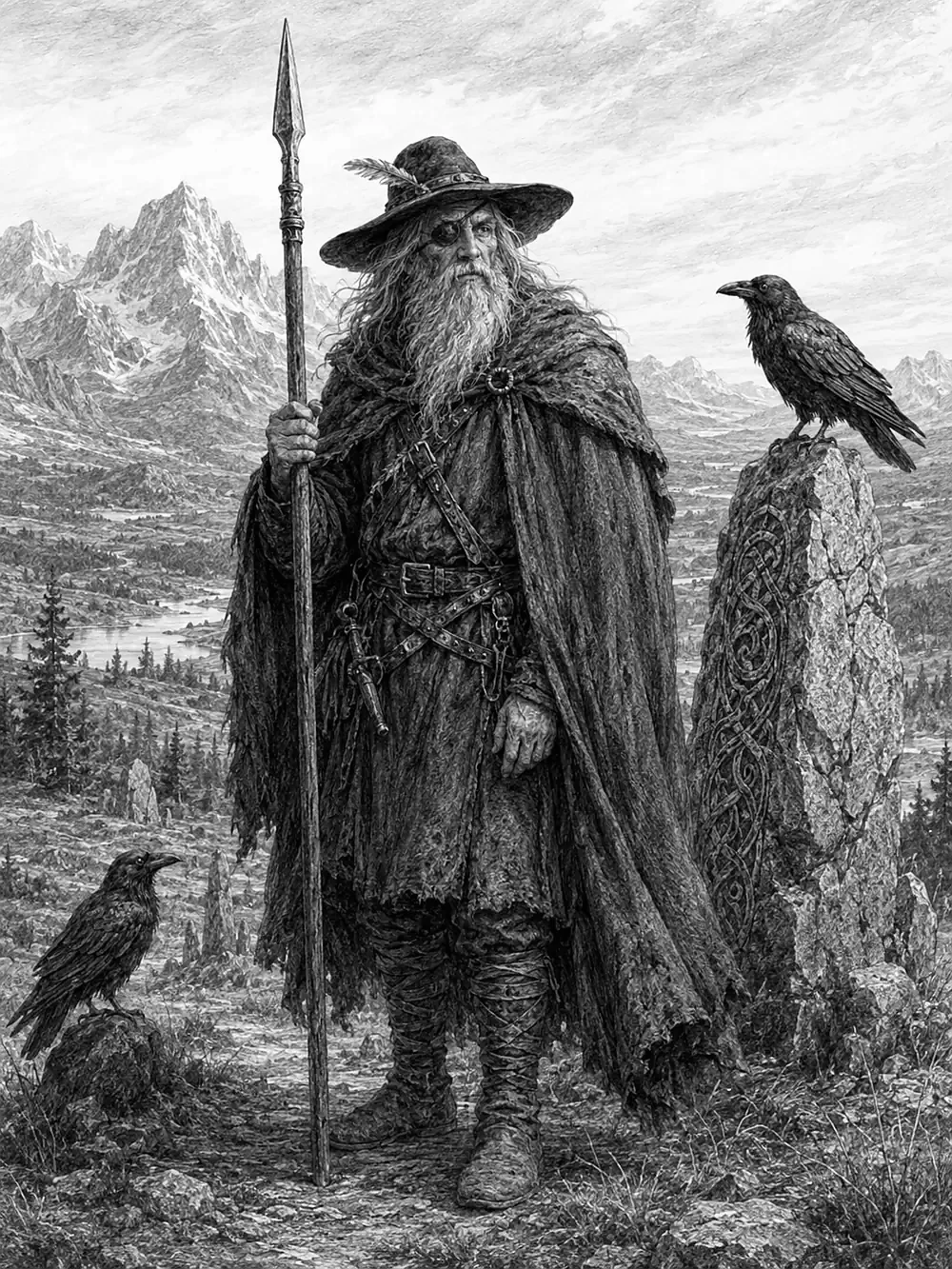
“Washed and fed to the council fare,Hávamál 61 · Bellows translation (public domain)
But care not too much for thy clothes;
Let none be ashamed of his shoes and hose,
Less still of the steed he rides.”
The Old Norse behind this stanza opens þveginn ok mettr — "washed and fed." Before the assembly, before you are seen and judged, the poem's counsel is simple: arrive clean and arrive nourished, and do not be ashamed of what you cannot afford. It is not about looking wealthy. It is about carrying yourself with dignity from wherever you actually stand. That is grooming's real place in a portable practice: not vanity, and not a costume, but the same hearth-tending you already do for a room, turned toward the body.
What the sources actually say
This topic is thick with myth, internet bravado, and bad history. So the honest version matters. Here is what is actually attested, and what is not.
The inclusive hearth applies here too
Beard-and-Viking content is one of the most heavily co-opted corners of this whole subject, so this needs saying plainly. A beard is not a badge of Norse identity, masculinity, or belonging. It is not more "authentic," more "Heathen," or more anything. Plenty of devout practitioners are clean-shaven, cannot grow facial hair, are women, are nonbinary, or keep a beard for reasons that have nothing to do with the gods. Grooming here is a practice of self-respect open to everyone — never a marker that sorts people into "real" and "fake." If a grooming community starts implying otherwise, walk away from it.
For barracks and regulation life
Many readers here are active-duty, veterans, or in other regulated environments where the choice about facial hair is not entirely yours. That does not put you outside this practice — it puts you at the center of it. Hávamál 61 does not say "grow a beard." It says arrive washed and fed, and do not be ashamed. A high-and-tight kept sharp is as much hearth-tending as a long beard combed out. The discipline is the devotion; the specific style is just circumstance.
- Work within the reg, not against it. Whatever your grooming standard is, meeting it cleanly and consistently is the practice. Readiness is the point the poem keeps returning to.
- Shave as a rite, not a rush. A morning shave done with attention — clean blade, warm water, unhurried — is a portable daily discipline that needs no altar and breaks no rule.
- Transition seasons. If you leave a beard-restricted role, growing one out afterward can mark the change honestly. If you enter one, letting it go can be its own kind of vow kept.
On military beard accommodations
Because this comes up often, here is a plain, factual account of how U.S. military religious beard accommodations actually work — and how much they are changing. This site does not advise anyone on how to pursue one; that is a conversation for your chaplain, your chain of command, and the current regulation.
- Chaplains do not grant beard waivers. A chaplain interview is one part of a religious-accommodation packet, and its purpose is to assess whether a belief is sincerely held. Chaplains may make a recommendation, but the approving authority is a commander in the chain, with a legal advisor reviewing for compliance. The memorandum a service member carries comes from command, not the chaplain.
- The legal basis is sincerity, not scripture. These accommodations rest on the Religious Freedom Restoration Act, whose standard is whether the individual sincerely holds the belief — not whether the religion requires the practice. Heathenry encourages but does not require beards, and the Poetic Edda contains no command to grow one. Waiver templates that assert "the Eddas require beards" are stating something the sources do not support.
- The policy tightened sharply in 2025–2026. Following a September 2025 directive and a March 11, 2026 Department of Defense memo, all branches raised the documentation and sincerity requirements, limited beard accommodations toward non-deployable roles, and required existing accommodations to be re-evaluated. The Army's May 19, 2026 directive added a sworn-statement requirement and a re-application process. Reporting on the new DoD religion guidance indicates some faith groups previously recognized for these waivers — including Heathen and Pagan groups — were affected. This is a fast-moving area.
- Verify before you rely on anything here. Grooming and accommodation policy is changing quickly and differs by branch. Treat this paragraph as background only, and confirm the current standard through your chaplain, your unit, and the governing regulation for your service.
A portable grooming kit
Small, cheap, deniable, and just as at home in a barracks locker, a hotel bag, or an apartment drawer as anything else on this site.
- A comb — wood or bone if you like the old resonance, plastic if that’s what you have. The Norse carried combs everywhere; so can you.
- A blade or trimmer you keep clean and sharp.
- A small soap or oil. Skip the marketing; any mild, unscented option does the work.
- A cloth — the same one that unrolls as a pocket altar can dry a washed face.
- Clean water. The one offering, and the one washing, that works anywhere.
The washed-and-fed rite
A two-minute daily practice that turns ordinary grooming into hearth-tending. No flame, no display, no explanation owed to anyone.
- Wash your face and hands with clean, warm water. Feel it as a small threshold between sleep and the day.
- Groom to your own standard or your regulation’s — comb, trim, or shave, without hurry.
- Recall or read the line: "washed and fed to the council fare." Let it mean: I meet the day with dignity, from wherever I stand.
- Eat or drink something, however small. The poem pairs washed with fed for a reason — care for the body is not separate from the practice.
- Name one thing you will carry into the day with self-respect: patience, steadiness, honesty, readiness.
Substance use, moderation, and sobriety
Tending the body honestly means naming this too. There is a loud cultural myth that Norse practice means hard drinking — the mead-hall, the horn, the "Viking" who out-drinks everyone. It is worth saying plainly: sobriety does not make you any less of a Heathen, any less devout, or any less welcome at this hearth. If anything, the Hávamál is on the side of the person who knows their limit.
The old poem is unusually direct about drink. It does not forbid mead, but it warns — again and again — against losing your wits to it, and it treats knowing your own measure as a mark of wisdom rather than weakness. In one of its most famous images, it says even the grazing herd knows when it has had enough and turns home; the fool is the one who never learns the measure of his own belly. That is not a verse against drinking. It is a verse for self-knowledge.
“The herds know well when home they shall fare,Hávamál 21 · Bellows translation (public domain)
And then from the grass they go;
But the foolish man his belly’s measure
Shall never know aright.”
The poem sets the ordinary animal above the heedless person on exactly one point: the beast knows when it has had its fill and stops. Restraint here is not shame or denial — it is a kind of clarity the poem openly admires. Knowing your measure, in drink or anything else, is wisdom, not deprivation. And the poem’s companion line is just as plain: “Shun not the mead, but drink in measure.” (Hávamál 19). For some people the honest measure is none — and the poem’s logic holds all the way down to zero.
Mead is traditional in blót and sumbel, but it is never required. Toasts are made with intention, not with proof — water, tea, juice, or cider carry a toast exactly as well, and many groups keep a non-alcoholic horn as standard. If you are sober, in recovery, on duty, pregnant, on medication, or simply choose not to drink, your offering and your oath are complete as they are. No one at this hearth should ever pressure you toward a drink.
Where in your life do you already know your measure — and where do you override it? Name one place you can let the herd’s plain wisdom win: stop when it is enough, and turn home.
From the verse
“Washed and fed to the council fare,Hávamál 61 · Bellows translation (public domain)
But care not too much for thy clothes;
Let none be ashamed of his shoes and hose,
Less still of the steed he rides.”
The stanza refuses two extremes at once: do not neglect yourself, and do not be ashamed of what you lack. Arrive clean; arrive fed; hold your head up in worn shoes on a poor horse. Dignity is not bought. It is tended.
Once this week, groom with full attention rather than on autopilot — not to impress anyone, but as an act of self-respect owed to the person who has to live your day. Then step out without apologizing for what you couldn’t afford or weren’t allowed.
Where do you confuse being groomed with being worthy — and where do you withhold basic care from yourself? Write one small act of washed-and-fed dignity you can keep daily.