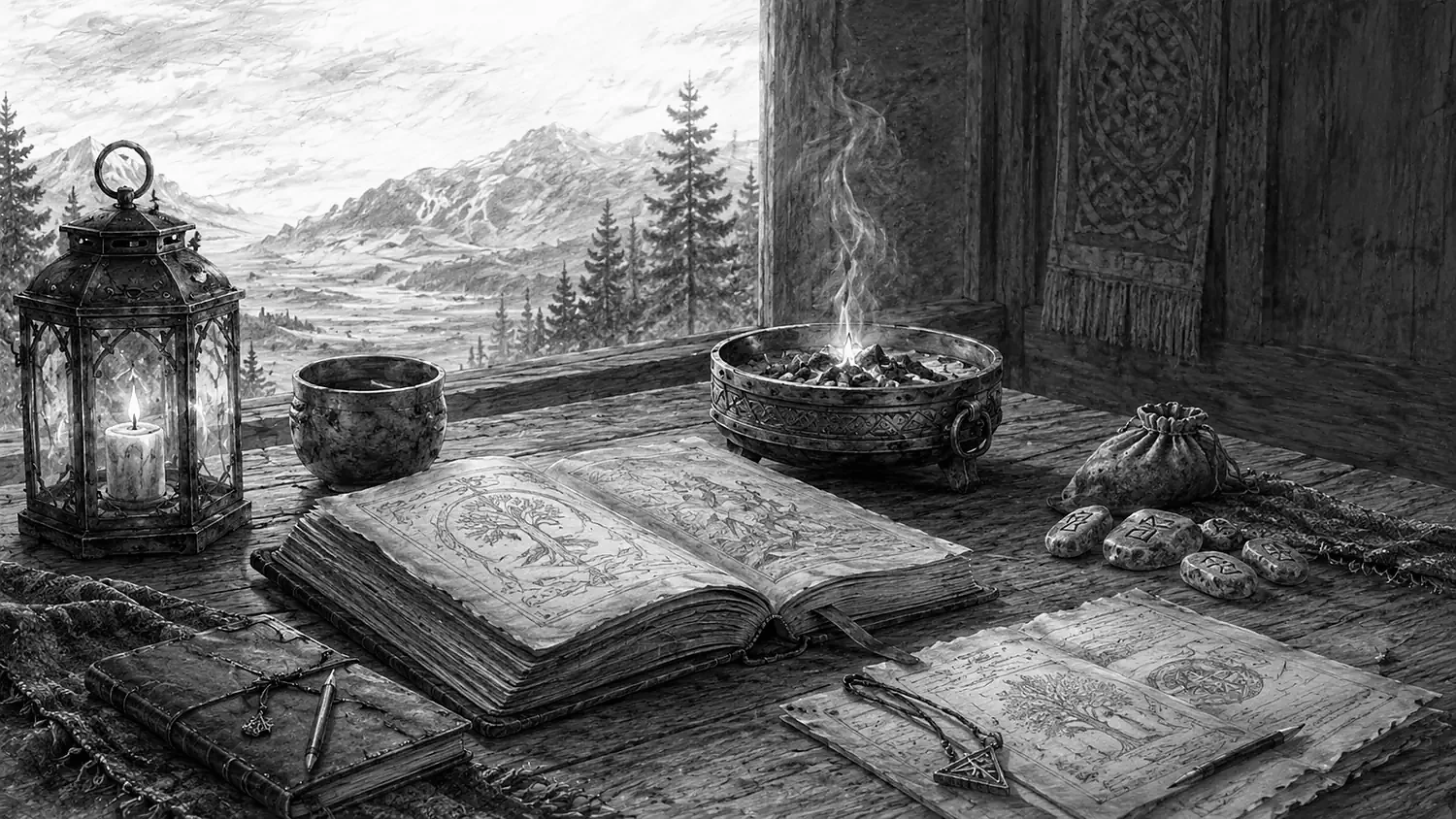
Modern Heathenry is more practice than creed. There is no one central boss, no required script, and no single book that settles every argument. What holds it together is action and relationship. Everything here scales down to one person with a cup of water, or up to a room full of people — the bones stay the same.
The two central rites
Most of the rest builds from these two. A holiday can be a blót and a sumbel on a meaningful day. A wedding can be a sumbel with oaths at the center. Learn the bones and you can stop waiting for someone else to hand you a script.
- Blót say "bloat"
- A gift to the gods, honored dead, or land-spirits. Historically this could be an animal sacrifice shared as a feast; in modern practice it is almost always an offering of food or drink — mead, ale, bread, water — given with thanks and then shared or poured out. The heart of it is the gifting cycle: a gift given, a bond deepened, a gift returned. It can be done alone or in a group, indoors or out.
- Sumbel say "sumble"
- A ritual of toasting. People sit together, a horn or cup is filled and passed, and rounds of toasts are made — commonly one round to the gods, one to the honored dead and heroes, and one open round for boasts, oaths, and honoring. Unlike blót, sumbel is a communal act; it strengthens the bonds between everyone present, living and honored dead. It is where oaths are most solemnly sworn.
A simple blót you can do anywhere
No horn, no altar, no group required. Water in a cup works.
- Set a clean cup of drink on a clean surface.
- Name who the gift is for — a god, the honored dead, the spirits of your home, or simply "the powers that keep me."
- Speak your thanks, and any request, plainly and honestly.
- Offer: pour a share outside, into soil, or down the sink with intention; drink or share the rest.
- Note what you gave and why. The gifting cycle is built by repetition.
A sumbel toast, even alone
A full sumbel wants company, but you can keep its spirit solo: raise your cup three times — once to a god or the high powers, once to someone you have lost, once to a hope you are willing to work for. Say each aloud. Words spoken over the cup have weight; mean them.
Who and what Heathens honor
Heathenry is broadly polytheistic and animistic — a world full of powers and persons, not all of them human. Most practitioners tend three kinds of relationship, and you need not honor all the same way.
- The gods
- The Æsir and Vanir — Odin, Thor, Frigg, Freyja, Týr, Freyr, and many more. Few Heathens worship the whole pantheon equally; most build relationships with a few gods whose domains meet their life. There is no requirement to worship any specific deity, and no test of belief you must pass first. See the devotional-art note on the home page for how this site treats depictions of them.
- The honored dead
- The remembered dead, elders, teachers, friends, chosen family, and people whose example you carry. Remembrance practice is memory turned into action: naming people, telling stories, learning from their lives, and refusing to repeat the harm worth ending. This site treats remembrance as memory, gratitude, and responsibility - never as purity, rank, or spiritual authority.
- The wights land- & house-spirits
- The spirits of place — of the land you live on (land-wights) and the home you keep (house-wights). Right relationship with them means respect, small regular offerings, and not fouling or harming the place. This is where Heathenry becomes intensely local and portable at once: the wights of your actual apartment, block, or desert are the ones you tend.
Wyrd: why oaths matter
A central Heathen concept is wyrd — the woven web of cause and consequence connecting all actions across time. What you do lays threads that shape what can happen next, for you and for those around you. This is why the sources take oaths and even boasts so seriously: words spoken in a sacred setting are actions that bind. It is also why this site keeps returning to small, kept vows. You are always weaving your wyrd; the practice is to weave it honestly.
The values question
You will encounter lists of Heathen "virtues" — most famously the Nine Noble Virtues. Be aware: these are a modern compilation, assembled by twentieth-century organizations, not an ancient creed handed down intact. Many of the values they name (courage, hospitality, honesty, perseverance, self-reliance, keeping one's word) genuinely echo the ethics of Hávamál — but the numbered list itself is new, is not scripture, and versions of it have been promoted by folkish groups. Take the good counsel of the poems directly; hold any tidy virtue-list lightly.
Where to go next
- New to all of this? Begin with the seven-day beginning, then come back here to add a blót or a toast.
- Want the poems behind the practice? The Edda Practice page turns stanzas into action.
- Ready to mark the year or a life event? See The Heathen Year and Rites of Passage.
- Curious about the runes? See The Runes — what they were, where their meanings come from, and how to use them honestly.